
Best Daycare Centers in Richmond, TX: What Parents Should Look For
Choosing the right daycare is one of the most important decisions parents make during their child’s early years. A quality childcare environment does more than provide supervision while parents work. It gives children opportunities to explore, develop social skills, build confidence, and establish the foundations for lifelong learning.
For families searching for the Best Daycare Richmond TX has to offer, the number of available options can make the decision challenging. Different daycare centers offer different educational approaches, schedules, facilities, and childcare programs. While some focus primarily on supervision, others combine structured learning, creative activities, and age-appropriate developmental experiences.
Parents in Richmond, TX, should therefore look beyond convenient locations and affordable tuition when evaluating childcare options. Understanding what makes a daycare center safe, supportive, and educational can help families make a more informed decision.
Whether you are looking for infant care, toddler programs, preschool preparation, or a comprehensive early learning environment, knowing what to look for can make your search considerably easier.
How to Choose the Best Daycare in Richmond, TX
Finding the right daycare requires balancing your child’s developmental needs with your family’s daily routine. The best childcare option is one where children feel comfortable, parents feel confident, and learning is incorporated into everyday activities.
Here are the most important factors to consider when comparing daycare centers in Richmond, TX.
1. Check Licensing, Safety, and Compliance
Safety should always be the first consideration when evaluating a daycare center. Before enrolling your child, confirm that the facility holds the appropriate Texas childcare license and follows the state’s health and safety requirements.
The Texas Health and Human Services Commission (HHSC) regulates childcare operations and establishes minimum standards designed to protect children’s health, safety, and well-being. Parents can also review inspection records and compliance information before making a decision.
Texas Health and Human Services+1
During your visit, look for:
-
Secure entrances and controlled visitor access.
-
Clean classrooms, bathrooms, and play areas.
-
Safe sleeping arrangements for infants.
-
Age-appropriate furniture, toys, and playground equipment.
-
Clearly communicated emergency procedures.
-
Proper supervision during indoor and outdoor activities.
-
Written policies for illness, medication, and allergies.
Ask the director how staff handle emergencies, injuries, and unexpected situations. A responsible daycare should be comfortable explaining its safety procedures and allowing parents to understand how children are supervised.
2. Evaluate Teachers and Caregiver Qualifications
Teachers and caregivers have a significant influence on children’s early development. Their experience, communication skills, patience, and ability to understand different developmental stages can make a considerable difference in a child’s daycare experience.
When visiting a Daycare Center Richmond TX families are considering, pay attention to how teachers interact with children.
Qualified caregivers should demonstrate:
-
Patience when responding to children’s needs.
-
Positive communication and encouragement.
-
Knowledge of age-appropriate activities.
-
Awareness of children’s emotional and developmental needs.
-
Proper training in safety and emergency response.
-
The ability to manage classroom routines effectively.
Also ask about staff turnover. Consistent caregivers can help young children develop trust and feel secure in their surroundings.
A welcoming classroom is not simply one with attractive decorations. It is one where teachers actively engage with children, encourage curiosity, and respond thoughtfully to their individual needs.
3. Look for Age-Appropriate Learning Programs
Daycare should be more than a place where children spend time until their parents finish work. Early childhood is an important period for developing communication, problem-solving, creativity, motor skills, and social interaction.
The best childcare programs introduce learning through activities that match each child’s age and abilities.
For example:
| Age Group | Important Development Areas | Suitable Activities |
|---|---|---|
| Infants | Sensory development, bonding, early communication | Music, supervised tummy time, sensory play |
| Toddlers | Language, movement, independence | Storytime, building blocks, interactive games |
| Preschoolers | Early literacy, numbers, social skills | Counting, drawing, storytelling, group activities |
| School-age children | Confidence, creativity, problem-solving | Homework support, projects, creative play |
Parents should ask whether the daycare follows a structured curriculum or developmental learning plan.
A quality program balances guided instruction with opportunities for exploration. Children should have enough freedom to discover new interests while receiving appropriate guidance from their teachers.
4. Consider Classroom Cleanliness and Facilities
The physical environment plays an important role in children’s comfort and safety. A well-maintained daycare should provide clean, organized, and age-appropriate spaces where children can participate in different activities.
During your visit, examine the following:
-
Classroom ventilation and lighting.
-
Clean floors, surfaces, and shared toys.
-
Properly maintained bathrooms.
-
Separate spaces for different age groups where appropriate.
-
Safe indoor and outdoor play equipment.
-
Accessible handwashing facilities.
-
Comfortable spaces for rest and quiet activities.
Outdoor play areas are also worth examining. Children benefit from opportunities to move, explore, and participate in supervised physical activities.
Do not hesitate to ask how frequently classrooms and toys are cleaned. A professional childcare provider should have established cleaning and sanitation routines.
5. Understand Daily Schedules and Activities
Children benefit from predictable routines. A balanced daycare schedule helps them understand what to expect throughout the day while providing opportunities for learning, play, rest, and social interaction.
A typical daycare schedule may include:
| Time | Activity | Developmental Benefit |
|---|---|---|
| Morning | Arrival and free play | Social interaction and adjustment |
| Morning session | Learning activities | Cognitive and language development |
| Mid-morning | Snack time | Healthy eating habits |
| Late morning | Outdoor play | Physical development |
| Afternoon | Lunch and rest | Nutrition and recovery |
| Later afternoon | Creative activities | Imagination and self-expression |
| Closing hours | Group play and pickup | Social development and routine |
Actual schedules vary depending on children’s ages and the daycare’s educational approach.
Ask the provider for a sample daily schedule. Make sure it includes enough time for physical movement, creative exploration, rest, and age-appropriate learning.
6. Review Communication Between Parents and Teachers
Parents should never feel disconnected from their child’s daycare experience.
Effective communication allows families to understand how their children are adjusting, what they are learning, and whether any concerns require attention.
When comparing Childcare Richmond TX providers, ask how they communicate with parents.
Some useful questions include:
-
Do teachers provide daily activity updates?
-
Are parents informed about meals and naps?
-
How are accidents or injuries communicated?
-
Can parents schedule meetings with teachers?
-
How does the center communicate developmental concerns?
-
Are parents informed about upcoming events and activities?
Regular communication builds trust and allows parents and teachers to work together in supporting a child’s development.
7. Compare Tuition, Operating Hours, and Convenience
Cost is another important consideration when choosing a daycare. However, the lowest tuition does not necessarily represent the best value.
Parents should compare what each childcare provider includes in its fees and whether its operating schedule accommodates their family’s routine.
Consider the following:
| Factor | What Parents Should Check |
|---|---|
| Tuition | Weekly or monthly fees |
| Enrollment | Registration and additional fees |
| Operating hours | Opening and closing times |
| Meals | Whether meals and snacks are included |
| Schedule | Full-time and part-time availability |
| Holidays | Holiday closures and scheduled breaks |
| Additional services | Transportation and extracurricular activities |
Also consider the daycare’s location relative to your home, workplace, and your child’s school.
A conveniently located center can make morning drop-offs and afternoon pickups significantly easier.
8. Look for a Positive and Nurturing Environment
A child’s emotional well-being is just as important as physical safety and educational development.
Some children adjust to daycare quickly, while others need more time to become comfortable with unfamiliar people and surroundings. A nurturing environment can make this transition easier.
Observe whether:
-
Teachers greet children warmly.
-
Children appear comfortable approaching caregivers.
-
Staff respond calmly when children become upset.
-
Teachers encourage sharing and cooperation.
-
Children have opportunities to express themselves.
-
Individual needs and personalities are respected.
A good daycare does not expect every child to learn, communicate, or adjust at the same pace. Instead, teachers recognize individual differences and provide appropriate support.
Parents should also ask whether the center has a transition process for newly enrolled children. Gradual introductions, familiar routines, and consistent communication can help children feel more secure.
9. Check for Texas Rising Star Certification
Texas Rising Star is an important quality indicator parents should understand when researching childcare providers.
It is a voluntary quality rating and improvement system for eligible childcare providers in Texas. The program evaluates childcare quality beyond basic state licensing requirements.
Its quality standards cover areas such as:
-
Classroom interactions and teaching practices.
-
Curriculum and learning experiences.
-
Teacher qualifications and professional development.
-
Family engagement.
-
Health and safety practices.
Texas Rising Star providers receive ratings based on their demonstrated quality standards. Parents can use these ratings as an additional comparison tool when researching local childcare options.
Texas Child Care Connection+1
However, certification should not be the only factor influencing your decision. Parents should still visit the facility, meet teachers, review inspection records, and evaluate whether the program suits their child’s needs.
You can learn more about the certification process through the official Texas Child Care Connection quality childcare guide.
Important Questions to Ask During a Daycare Tour
Visiting a childcare center is one of the most effective ways to understand its environment. Online photographs, reviews, and program descriptions can provide useful information, but they cannot replace seeing how the center operates.
When touring a potential daycare, prepare questions that help you evaluate its quality.
Here are some important questions to ask:
| Category | Questions to Ask |
|---|---|
| Licensing | Is the facility currently licensed by Texas HHSC? |
| Safety | What security and emergency procedures are followed? |
| Staff | What qualifications and training do teachers have? |
| Supervision | What are the staff-to-child ratios for each age group? |
| Curriculum | What learning approach or curriculum does the center follow? |
| Meals | Are meals and snacks provided? |
| Health | What happens if a child becomes sick during the day? |
| Communication | How do parents receive updates about their children? |
| Availability | Are spaces available for my child’s age group? |
| Fees | Are there additional registration or activity charges? |
Texas Child Care Connection also recommends contacting potential providers, asking about schedules and costs, reviewing inspection information, and arranging tours before making a final decision.
Texas Child Care Connection+1
A useful tip: If possible, schedule your tour during normal operating hours. This gives you an opportunity to observe actual classroom activities, teacher interactions, and children’s daily routines.
Comparing Different Childcare Options in Richmond, TX
Richmond families can explore several types of childcare arrangements. The right choice depends on the child’s age, developmental needs, family schedule, and preferred learning environment.
Understanding the differences can help narrow your search.
| Childcare Option | Best Suited For | Main Benefits |
|---|---|---|
| Infant daycare | Babies requiring regular care | Feeding routines, sensory experiences, responsive supervision |
| Toddler daycare | Young children developing independence | Language development, movement, social interaction |
| Preschool | Children around 2–3 years | Early learning, creative activities, classroom routines |
| Pre-K | Children approaching kindergarten | School readiness, early literacy, number recognition |
| After-school care | School-age children | Supervision, homework support, enrichment activities |
| Home-based childcare | Families preferring smaller settings | Potentially smaller groups and a home-like environment |
Not every childcare arrangement provides the same services. Some facilities specialize in younger children, while others offer programs covering several developmental stages.
Parents should choose based on their child’s current needs rather than simply selecting the center with the largest number of programs.
Why Early Childhood Education Matters
The early years of childhood provide valuable opportunities for learning and development.
Children develop essential abilities through everyday experiences, including conversations, play, movement, storytelling, and interaction with others.
A well-planned early childhood education program supports several important developmental areas.
Cognitive development
Activities involving counting, sorting, matching, puzzles, and exploration encourage children to think, recognize patterns, and solve simple problems.
Language and communication
Storytelling, songs, reading, and conversations help children develop vocabulary, listening skills, and confidence in expressing themselves.
Social and emotional development
Group activities teach children how to share, cooperate, recognize emotions, and develop relationships with others.
Physical development
Outdoor play, movement activities, drawing, and hands-on tasks support coordination and motor skills.
Creativity and imagination
Art, music, pretend play, and storytelling give children opportunities to express ideas and explore their interests.
These experiences should be age-appropriate and enjoyable. Children do not need a highly academic classroom to develop important skills. Play-based learning can provide meaningful educational experiences while allowing children to enjoy their childhood.
What Makes Richmond Learning Academy Worth Exploring?
For parents researching the Best Daycare Richmond TX has available, Richmond Learning Academy is one local childcare provider worth including in their shortlist.
Located at 1500 Main Street, Richmond, TX 77469, Richmond Learning Academy provides childcare and early learning programs for children from infancy through school age.
The academy combines childcare with age-appropriate learning experiences, giving families an option to explore when looking for a nurturing educational environment.
Here are some of its key offerings.
Age-Appropriate Childcare Programs
Richmond Learning Academy offers several programs designed around different developmental stages.
| Program | Age Group | Main Focus |
|---|---|---|
| Infant Care | 6–12 months (website program listing) | Responsive care and early development |
| Toddler Program | Toddler age groups | Language, movement, and social skills |
| Preschool | 2–3 years | Early learning and creative exploration |
| Pre-K | 4 years | Kindergarten readiness |
| After-School Care | 5–12 years | Supervision and enrichment |
| Break Programs | School-age children | Activities and learning during school breaks |
Parents can explore individual programs through the academy’s website:
A Learning-Focused Approach
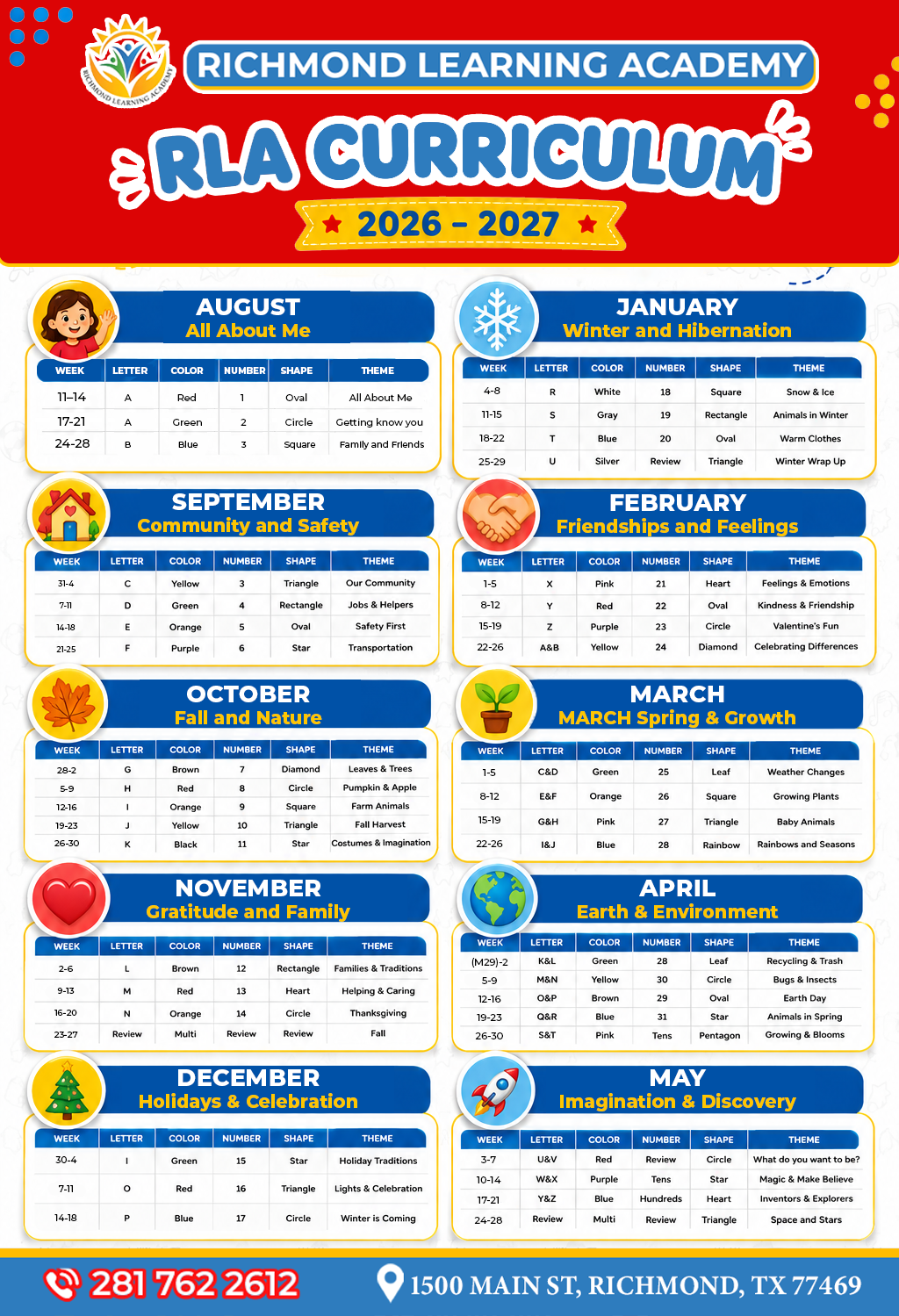
The academy uses the Frog Street curriculum, incorporating different areas of early childhood development.
Its learning approach includes:
-
Social-emotional learning.
-
Language and literacy development.
-
Early STEM concepts.
-
Physical development.
-
Creative arts.
-
Structured daily routines.
This combination gives children opportunities to develop foundational skills through guided activities and play.
Safety and Family Communication
The academy’s website highlights secured entry, camera monitoring, staff background checks, and daily health screenings as part of its safety approach.
It also describes family communication through photos, activity updates, and developmental milestone reports.
Parents should ask the academy to explain these procedures during their visit and demonstrate how communication works in practice.
Licensing and Quality Recognition
Richmond Learning Academy appears in the official Texas childcare provider directory as a licensed center with a full permit. The state directory lists its Texas Rising Star certification at three out of four stars.
childcare.hhs.texas.gov
This gives parents an opportunity to verify its regulatory information directly rather than relying exclusively on promotional claims.
Convenient Richmond Location
The academy is located at:
Richmond Learning Academy
1500 Main Street, Richmond, TX 77469
Phone: 281-762-2612
Operating hours listed on its website: Monday–Friday, 6:30 AM–7:30 PM.
Its location makes it worth considering for families looking for childcare in Richmond and nearby Fort Bend County communities.
Parents interested in learning more can visit the About Richmond Learning Academy page or arrange a visit to explore its classrooms and programs.
How to Make the Final Daycare Decision
After researching different childcare providers, reviewing their programs, and visiting potential centers, parents should compare their findings before making a final decision.
Rather than focusing on a single feature, consider the overall experience each center offers.
Use this checklist to evaluate your shortlisted daycare centers:
You should also consider how the center responds to your questions. A professional childcare provider should be transparent about its policies, classroom routines, fees, and expectations.
Ultimately, the best daycare is not necessarily the biggest, most expensive, or most heavily advertised facility. It is the one that provides an environment where your child can feel safe, develop meaningful relationships, and enjoy learning.
Find the Right Daycare for Your Child in Richmond, TX
Choosing childcare is about finding a place where your child can grow while you have confidence in the care they receive.
For families searching for the Best Daycare Richmond TX, it is important to evaluate licensing, teacher qualifications, learning programs, classroom environments, communication, and convenience together.
Taking the time to visit different centers and ask meaningful questions can help you make a decision that supports both your child’s development and your family’s needs.
If you are exploring childcare options in Richmond, consider visiting Richmond Learning Academy to learn more about its infant, toddler, preschool, Pre-K, and school-age programs.
You can meet the teachers, explore the classrooms, understand the learning approach, and discuss your child’s individual needs before making an enrollment decision.
Give your child a nurturing place to learn, grow, and discover new possibilities. Schedule a visit to Richmond Learning Academy and explore the right childcare program for your family.
Frequently Asked Questions (FAQs)
1. What should parents look for when choosing the best daycare in Richmond, TX?
Parents should consider licensing, safety procedures, teacher qualifications, classroom cleanliness, age-appropriate learning programs, operating hours, and communication policies. Visiting the facility and observing classroom interactions can help determine whether it is suitable for their child.
2. How do I verify whether a daycare center in Richmond, TX is licensed?
Parents can use the Texas Health and Human Services Child Care Regulation website to search for childcare providers. The directory provides information about licensing, inspection history, and compliance records.
Visit the Texas Child Care Regulation website.
3. What is the difference between daycare and preschool?
Daycare primarily provides supervision and care for children while parents work or manage other responsibilities. Preschool combines childcare with structured early learning activities designed to develop language, social, cognitive, and foundational academic skills.
Some childcare centers offer both services through integrated programs.
4. At what age can children start daycare in Richmond, TX?
The starting age depends on the childcare provider and its available programs. Some centers accept infants, while others specialize in toddlers or preschool-aged children. Parents should confirm the minimum enrollment age and availability directly with the facility.
5. How much does daycare cost in Richmond, TX?
Daycare tuition varies depending on the child’s age, schedule, program, and services included. Infant care may have different pricing from toddler or preschool programs. Parents should request a current fee schedule and ask about registration fees, meals, and additional expenses.
6. What is Texas Rising Star certification?
Texas Rising Star is a voluntary quality rating and improvement system for eligible childcare providers in Texas. It recognizes providers that demonstrate quality standards beyond the state’s basic childcare licensing requirements.
7. What questions should I ask during a daycare visit?
Ask about teacher qualifications, staff-to-child ratios, daily schedules, safety procedures, meals, illness policies, tuition, and parent communication. You should also ask whether the center has openings for your child’s age group.
8. Does Richmond Learning Academy offer different childcare programs?
Yes. Richmond Learning Academy offers infant, toddler, preschool, Pre-K, after-school, and school-break programs. Families can contact the academy at 281-762-2612 or visit its website to discuss program details and enrollment availability.